




History of Visakhapuri Mary Matha Shrine
Once a proud village of fisher folk and poor people now acquired civilization and incarnated as Visakhapatnam of the modern man. Man is not a simple. He has extraordinary powers and prowess. He can control the air. He can win over the skies. He can manage the time. He can keep the oceans at bay. The Creator has bestowed man with great powers. He creates civilizations, raises cities and establishes factories and industries. Nature cooperates most bountifully with the efforts of man. It is true also in the case of Visakhapatnam. Dolphin Nose Yaraada mountain supported the efforts of man in creating one of the beautiful cities on the East Coast. Visakhapatnam sings the sweets melodies of the Italian of the East, Telugu. It is the international welcome song from Andhrapradesh. It earned a bright spot on the world map for the dignity of human labour. It has been the home and training ground for many scientists, poets and writers. Sir C.V. Raman began his career here and Sri Sri, the doyen of modern Telugu literature hailed from here. Visakhapatnam is the heart of the lively north Andhra and the heart beat of the Visalandhra.
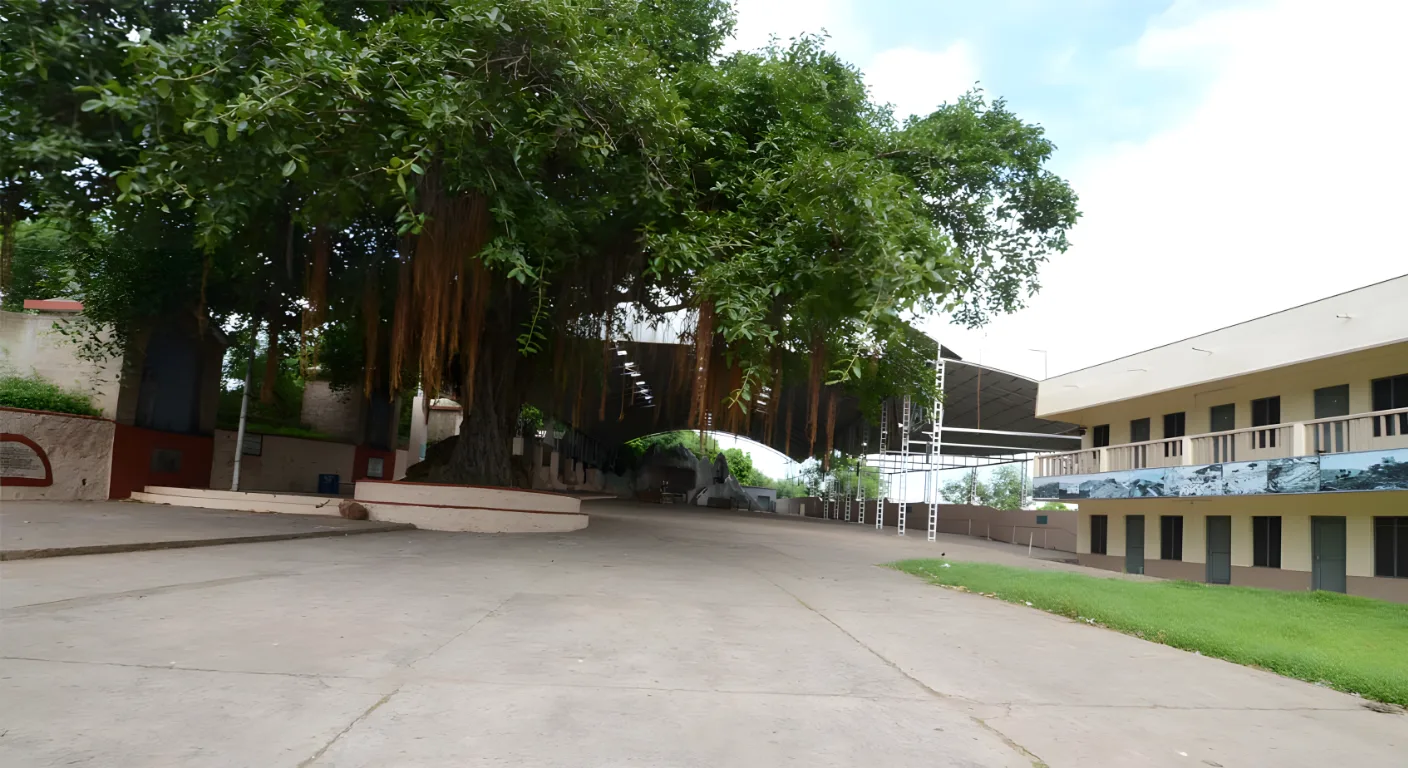
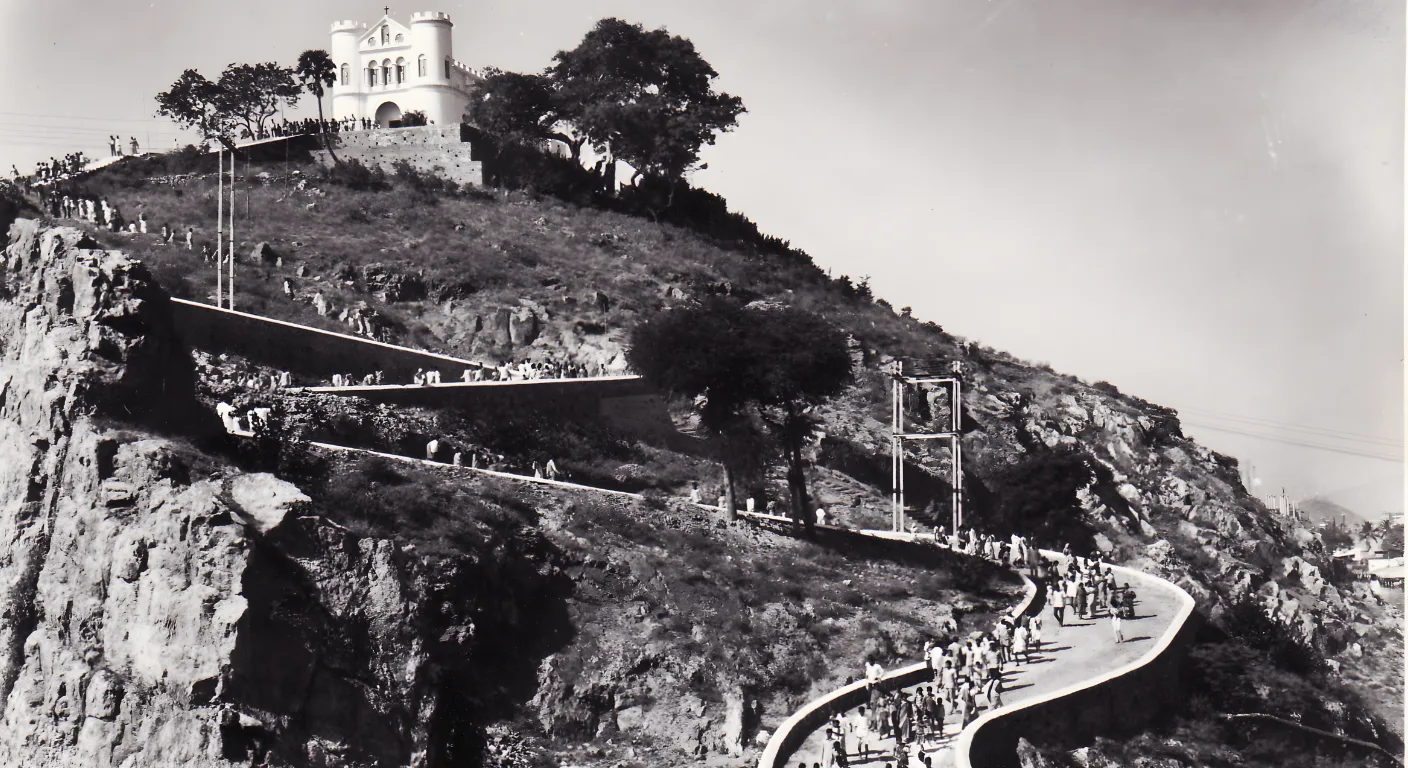
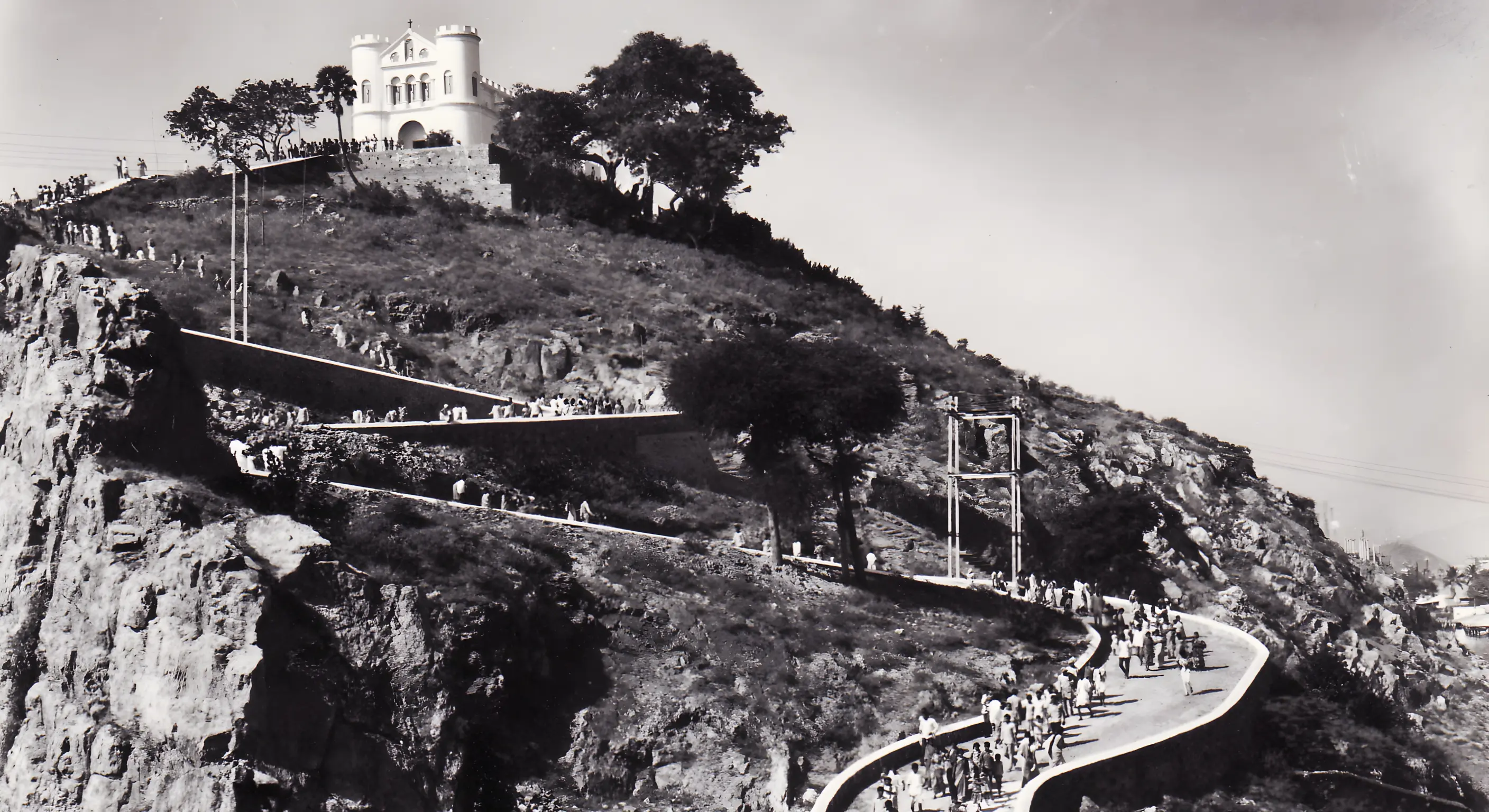
Since 1866, Visakhapuri Mary Matha Shrine, Ross Hill, is intertwined with the history of Visakhaptanam. There is divine atmosphere on this hill. It is recognized as a holy place by innumerable devotees for more than a century. Today it is regarded as the most popular pilgrim centre and the place of meeting the Divine by the people of the city irrespective of the caste or creed. Most of them, especially City Catholics call this Shrine as Kondagudi ( Church on the hill ). Parellel to the Light House on the Dolphine Nose hill, that guides the sailors safely, Visakhapuri Mary Matha Shrine on Ross Hill is the spiritual Light House that leads all the boats of human lives on this earth to the shores of Peace and Joy.
Parallel to the Dolphin Nose green mountain range, there is a small hillock. Between them a stream runs inside, rounding the hillock all the three sides and creating a natural harbour and many other industrial and defence opportunities. Mountains are abodes of God. They are the signs of his never ending steadfastness, majesty and greatness. This hill is made holy by the presence of three great religious places of worship and thus it stands out as a loud testimony of Visakhapatnam's religious tolerance and peaceful coexistence of religious traditions.
The shrine of Visakhapuri Mary Matha is undoubtedly God's own project and his own plan. It was the genuine need of the faithful. It developed naturally as the pointer of the way to God.
Arrival of the Missionaries: The Historical Background
"Go to the whole world and preach the good news." Mk 16:15. In obedience to this mission command of the Lord, Pope Gregory XVI who took up the reins of the Catholic Church in 1830, decided to reorganize the Indian church into new ecclesiastical units. Around four and half lakh square kilometers area was bifurcated and created as Visakhapatnam Vicariate. It was entrusted to the Missionaries of St. Francis De Sales, on 16th March, 1845.
On 19th Feb, 1846 they landed in Visakhapatnam port. Their arrival gave a big impetus to the evangelization work in this mission territory. By the time Missionaries of St. Francis De Sales (MSFS) had arrived, there were only 6000 Catholics in total. They were a mixed population of the Irish, Anglo-Indian, the French, Goans and Tamils. Before the arrival of MSFS missionaries in 1846, in the vast territory there were only four priests attending to the spiritual needs of the faithful.
Ross Hill … Visakha Hill
It was around 1850. Mr. W.H. Ross was working as a judge in the district Court. He was an English man nearing his retirement. He liked the serene and pleasant climate of Visakhapatnam. Unlike the other huge hills around, this hill captured his attention. It was unique in beauty and atmosphere. He was pulled and mesmerized. He wanted to own it.
So he bought it. He raised a beautiful residential building with a spacious hall and a few rooms with either side verandahs. He laid gardens on the western side. But man proposes and God disposes. Soon his eyes gave him trouble. He was slowly losing his sight. So he had to go back to England.
He sold his dream house to Captain Mappen. Captain Mappen and his family had no luck to enjoy the comfort. Many of his family members became sick. Then the ownership passed from one hand to another. Finally it was purchased by Mr. Achayya Naidu, local hindu merchant. Unfortunately his plan did not work out. Rumours spread among the locals that the house on the hill top was a haunted house.
Visakhapatnam and the Stations of its Progress
Visakhapatnam is a cosmopolitan city today. It is a gift of nature. Port is the best gift it gave to the people and it is the brightest jewel on the eastern coast of India. Nestled among the eastern ghats and facing the blue waters of the Bay of Bengal, Visakhapatnam is a picturesque city with a harmonious blend of the magical beauty of nature and the achievement of the modern man.
Matchless in beauty and landscape, Visakhapatnam is said to have derived its name from the deity 'Visaka' (the God of Valour) the son of Shiva and Parvati. The Dutch were the first among the Westerners who came for trade. In 1682 they traded worldwide with Bhimili as their centre. In 1765 the territory of northern circars ceded to the British East India Company by the Nizam of Hyderabad.
God's Plan – Bishop Tissot's Dream
The French missionaries, belonging to the Missionaries of St. Francis de Sales (MSFS) were great devotees of Mary. John Mary Tissot msfs (1810–1928) was the Bishop of Visakhapatnam Catholic diocese. He had deep personal devotion to Mary.
In his native Marseilles, France, there was a Shrine of Notre Dame de la Grande, facing the sea. The saintly bishop desired to construct such a Shrine. The Bay of Bengal was rough and source of sudden storms. He had acquired a plot on the Northern side of Dolphine's Nose Mountain. However, it was not accessible. The Bishop gave up and waited for Providence.
First Blessing of the Shrine
It was this time Mr. Achayya Naidu put forth his building, the haunted house, for sale. The bishop negotiated. The deal was struck for Rs. 700/-. The finances came from Mother Justin who had collected Rs. 1000/- through the artistic works of orphan girls.
On 15th August, 1887 Rev. Fr. Richard, the Vicar General, blessed the Chapel and dedicated it to Our Lady of Hope. Bishop Tissot himself would climb up and visit the chapel once or twice a month, waiting in faith and trust for a sign of Mary's favour.
Trials in the Beginning: Repeated Cyclones
In November 1870 there was a devastating cyclone in Visakhapatnam. Houses were destroyed. The floods did not spare the Hill Chapel. It was badly damaged.
In 1876 once again a fearsome cyclone hit. Bishop Tissot made a vow: if Mary protected his people, the shrine and the town, he would install the statue of Our Lady of the Immaculate Heart. His prayers were heeded. From then on there was protection for Visakhapatnam and the Shrine.
Bishop Tissot's Strong Will – Second Blessing
On 1st May, 1877 His Lordship Tissot blessed the Statue of the Immaculate Heart of Mary brought from France. People once again started to flock to the hill chapel. On the very day of blessing some people from the high castes accepted the Lord and received Baptism.
Fr. Selvam's Fruit of Labour: Chapel became Shrine
Fr. Selvam msfs, in 1878, was entrusted with the hill chapel. He toiled for 16 long years to bring it to shape. His enthusiasm attracted many devotees. Irrespective of caste or creed, everybody was touched and blessed.
Miracle that Proclaims the Power of Ross Hill
In 1884, a governess accidentally applied pure caustic acid to a child's eyes. The doctor declared them "hopelessly gone, literally burnt out." Rev. Mother Superior proposed a Novena to Our Lady on Ross Hill. On the morning of the 7th day, the child miraculously regained her sight, leaving the doctor in awe.
Another testimony: A bedridden Scotsman, unable to move for 18 months, was healed after his wife made a promise to offer a Mass at the Shrine. He saw "a beautiful lady" apply a soothing balm and lived for another 23 years.
New Century – New Decisions
By the turn of the new century, Hill Chapel established itself as the holy Shrine. Bishop John Mary Clerc msfs called all the priests to celebrate with triduum and a grand Procession from the Fort Catholic Chapel through the streets to the Hill Chapel.
The 1900 procession showed the church was much too small. Fr. Cyril Ailloud built the present church: 60 ft long, 40 ft broad and 32ft high. It was blessed by Bishop Clerc on 6th December, 1904, at a cost of Rs. 6840/-.
New Grotto Construction: Initiative of Rev. Fr. Joseph Baud
In 1939, Fr. Baud leveled the land behind the church and built a large grotto on the western end. A life-size statue of Our Lady of Lourdes was placed inside.
Bishop Rossillon's Vow
In April 1942, Japan was bombing Visakhapatnam. Bishop Rossillon prayed to Our Lady on 11th February, 1942 to protect the town. Mary's intercession was fruitful and the town was saved. On 10th February 1946, the Bishop conducted a special procession of gratitude.
Centenary Celebrations of the Shrine
1967 was the centenary year. A new tradition was initiated: extending the triduum into Novena (nine-day preparatory prayer programme). The road to the hilltop was completed by 1973, and for the first time a four-wheeler reached the top.
MSFS Religious Community at the Service of the Pilgrims
In 1972, Bishop Gopu Ignatius officially entrusted the Shrine to the Missionaries of St. Francis de Sales in perpetuity. The r.c.c. road was constructed as a joint venture with the Port Trust in October 1978.
Emergence as the Centre for Spiritual Growth
Mary Matha Dhyanashram (Mother Mary's House of Retreat) was established, offering spiritual enrichment programmes, seminars, prayer and fasting sessions.
Rosary Stations & Beautification
15 Rosary stations were erected from the foot to the top of the hill, blessed on 29th November, 1991. In 2005, Luminous Mystery stations were added with life-size statues from Kerala.
The Present is Golden
Today, pilgrims of all faiths visit from Visakhapatnam, Vijayanagaram, Srikakulam, East Godavari, and neighboring states. The Shrine stands as the spiritual resort and haven for devotees of North Coastal Andhra Pradesh — truly Mary's own abode.
Shrines And Their Theological Significance
Man is a religious being. He longs for transcendence. As Pope John Paul II said: "Shrines are like milestones that guide the Journey of the Children of God on Earth."
Bible has expounded the meaning of Shrine through three focal points: the "cosmic temple" (Ps 19), the Temple of Jerusalem where the Ark of the Covenant was kept, and the eternal Son of God, the Lord Jesus incarnated, died and risen (Jn 2: 19-21).
A Shrine serves three main purposes: First, it is a place of MEMORY of our origin and God's mighty deeds. Second, it is a place of renewing the covenant with God. Third, it points to Heaven as our destination.
In the long Catholic tradition, Mary has been considered as the Living Shrine. Mary is the living Shrine of the Word of God, the Ark of the New and Eternal Covenant.
Conclusion
Shrines are wombs of God and abodes of God. They facilitate encounters between God and devotee. Visiting a shrine is a moment of grace — an opportune time with potentiality to alter our lives.