The life of St. Francis de Sales reflects compassion, wisdom and unwavering faith. His writings and spiritual guidance shaped Catholic spirituality for generations.
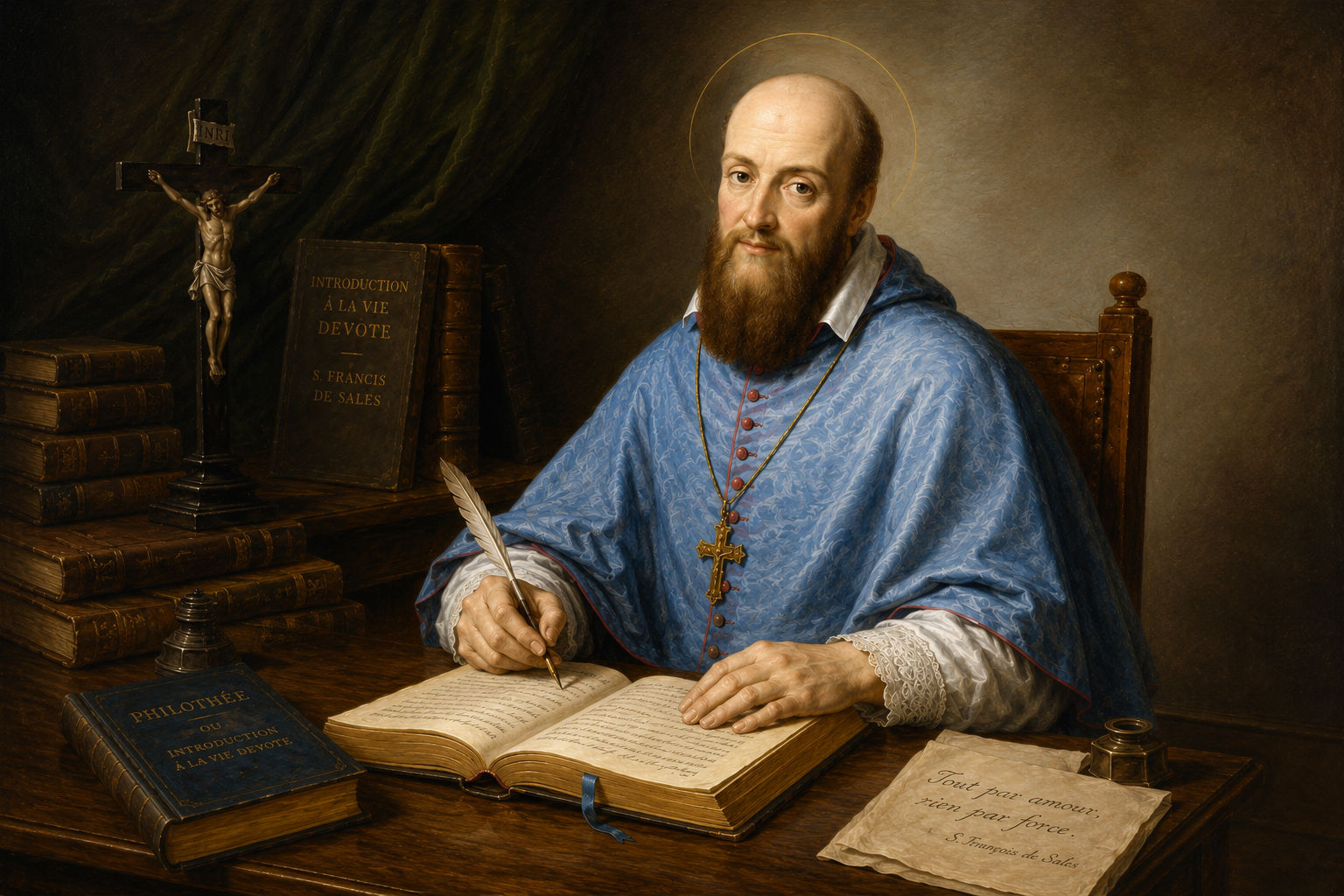
St. Francis de Sales, bishop of Geneva and a doctor of the Church, is renowned for the clarity of his teaching and preaching. Intellectually and spiritually tormented in his youth by debates over predestination, Saint Francis, upon arriving at a proper understanding of the question, was better able to treat with charity the Calvinists of Geneva, many of whom he brought back to the Catholic Church. He remains today a model of (in the words of the Institute of Christ the King Sovereign Priest, which as taken Saint Francis as one of its three chief patron saints) "living the truth in charity.
His famous works, including “Introduction to the Devout Life,” continue to guide Christians in prayer, holiness and daily living.
A historical journey through the life, mission, writings, and legacy of St. Francis de Sales.
| Year | Event |
|---|---|
| 1567 | 21st August - Birth of Francis at Thorens, Savoy. |
| 1573–78 | Schooling at La Roche and Annecy. |
| 1577 | First Communion and Confirmation. |
| 1578–81 | Grammar Studies in Paris. |
| 1584–88 | Arts and Philosophy studies in Paris. |
| 1588–92 | Law studies at Padua and receives Doctorate in Law. |
| 1592 | Admitted as Advocate to the Senate of Chambéry. |
| 1593 | Ordained priest and appointed Provost of Geneva Diocese. |
| 1594–98 | Missionary work in Chablais reconverting thousands. |
| 1595 | Publishes handwritten leaflets later known as The Catholic Controversy. |
| 1599 | Travels to Rome and appointed Co-adjutor Bishop of Geneva. |
| 1600 | Writes Defence of the Standard of the Cross. |
| 1602 | Consecrated Bishop of Geneva. |
| 1604 | Meets St. Jane Frances de Chantal. |
| 1607 | Co-founds the Institute of the Visitation. |
| 1609 | Publishes Introduction to the Devout Life. |
| 1610 | Foundation of the Order of the Visitation. |
| 1616 | Publishes Treatise on the Love of God. |
| 1622 | Dies at Lyons on December 28. |
| 1661 | Beatified by Pope Alexander VII. |
| 1665 | Canonized by Pope Alexander VII. |
| 1877 | Declared Doctor of the Universal Church by Pope Pius IX. |
Bishop of Geneva, Doctor of the Universal Church. Born at Thorens, in the Duchy of Savoy, 21 August, 1567; died at Lyons, 28 December, 1622. His father, François de Sales de Boisy, and his mother, Françoise de Sionnaz, belonged to old Savoyard aristocratic families. The future saint was the eldest of six brothers. His father intended him for the magistracy and sent him at an early age to the colleges of La Roche and Annecy. From 1583 till 1588 he studied rhetoric and humanities at the college of Clermont, Paris, under the care of the Jesuits. While there he began a course of theology. After a terrible and prolonged temptation to despair, caused by the discussions of the theologians of the day on the question of predestination, from which he was suddenly freed as he knelt before a miraculous image of Our Lady at St. Etienne-des-Grès, he made a vow of chastity and consecrated himself to the Blessed Virgin Mary.
In 1588 he studied law at Padua, where the Jesuit Father Possevin was his spiritual director. He received his diploma of doctorate from the famous Pancirola in 1592. Having been admitted as a lawyer before the senate of Chambéry, he was about to be appointed senator. His father had selected one of the noblest heiresses of Savoy to be the partner of his future life, but Francis declared his intention of embracing the ecclesiastical life. A sharp struggle ensued. His father would not consent to see his expectations thwarted. Then Claude de Granier, Bishop of Geneva, obtained for Francis, on his own initiative, the position of Provost of the Chapter of Geneva, a post in the patronage of the pope. It was the highest office in the diocese, M. de Boisy yielded and Francis received Holy Orders (1593).
From the time of the Reformation the seat of the Bishopric of Geneva had been fixed at Annecy. There with apostolic zeal, the new provost devoted himself to preaching, hearing confessions, and the other work of his ministry. In the following year (1594) he volunteered to evangelize Le Chablais, where the Genevans had imposed the Reformed Faith, and which had just been restored to the Duchy of Savoy. He made his headquarters in the fortress of Allinges. Risking his life, he journeyed through the entire district, preaching constantly; by dint of zeal, learning, kindness and holiness he at last obtained a hearing. He then settled in Thonon, the chief town. He confuted the preachers sent by Geneva to oppose him; he converted the syndic and several prominent Calvinists. At the request of the pope, Clement VIII, he went to Geneva to interview Theodore Beza, who was called the Patriarch of the Reformation. The latter received him kindly and seemed for a while shaken, but had not the courage to take the final steps. A large part of the inhabitants of Le Chablais returned to the true fold (1597 and 1598). Claude de Granier then chose Francis as his coadjutor, in spite of his refusal, and sent him to Rome (1599).
Pope Clement VIII ratified the choice; but he wished to examine the candidate personally, in presence of the Sacred College. The improvised examination was a triumph for Francis. "Drink, my son", said the Pope to him. "from your cistern, and from your living wellspring; may your waters issue forth, and may they become public fountains where the world may quench its thirst." The prophesy was to be realized. On his return from Rome the religious affairs of the territory of Gex, a dependency of France, necessitated his going to Paris. There the coadjutor formed an intimate friendship with Cardinal de Bérulle, Antoine Deshayes, secretary of Henry IV, and Henry IV himself, who wished "to make a third in this fair friendship". The king made him preach the Lent at Court, and wished to keep him in France. He urged him to continue, by his sermons and writings, to teach those souls that had to live in the world how to have confidence in God, and how to be genuinely and truly pious.
On the death of Claude de Granier, Francis was consecrated Bishop of Geneva (1602). His first step was to institute catechetical instructions for the faithful, both young and old. He made prudent regulations for the guidance of his clergy. He carefully visited the parishes scattered through the rugged mountains of his diocese. He reformed the religious communities. His goodness, patience and mildness became proverbial. He had an intense love for the poor, especially those who were of respectable family. His food was plain, his dress and his household simple. He completely dispensed with superfluities and lived with the greatest economy, in order to be able to provide more abundantly for the wants of the needy. He heard confessions, gave advice, and preached incessantly. He wrote innumerable letters and found time to publish the numerous works mentioned below. Together with St. Jane Frances de Chantal, he founded (1607) the Institute of the Visitation of the Blessed Virgin. His zeal extended beyond the limits of his own diocese. He delivered the Lent and Advent discourses which are still famous. During his last stay in Paris (1618–1619) he had to go into the pulpit each day to satisfy the pious wishes of those who thronged to hear him. He came into contact here with all the distinguished ecclesiastics of the day, and in particular with St. Vincent de Paul.
In 1622 he had to accompany the Court of Savoy into France. At Lyons he insisted on occupying a small, poorly furnished room in a house belonging to the gardener of the Visitation Convent. There, on 27 December, he was seized with apoplexy. He received the last sacraments and made his profession of faith, repeating constantly the words: "God's will be done! Jesus, my God and my all!" He died next day, in the fifty-sixth year of his age. Immense crowds flocked to visit his remains, which the people of Lyons were anxious to keep in their city. With much difficulty his body was brought back to Annecy, but his heart was left at Lyons. St. Francis de Sales was beatified in 1661, canonized by Alexander VII in 1665, and proclaimed Doctor of the Universal Church by Pope Pius IX in 1877.
O blessed Francis de Sales, who on earth did excel in a life of virtue, especially in the love of God and neighbor, I earnestly ask you to take me under your compassionate care and protection. Obtain for me conversion of mind and heart. Grant that all people, especially (names of those whom you wish to include) may experience the depth of God’s redeeming and healing love.
Teach me to fix my eyes on the things of heaven even as I walk each day with my feet planted firmly on the earth. Help me, through the practice of virtue and the pursuit of devotion, to avoid anything that would otherwise cause me to stumble in my attempt to follow Christ and to be an instrument of the Holy Spirit.
Encouraged by your prayers and example, help me to live fully my sacred dignity with the hope of experiencing my sacred destiny: eternal life with God. Receive also this particular need or concern that I now lift up in prayer. (mention your particular need).
O God, for the salvation of all, you desired that St. Francis de Sales—preacher, missionary, confessor, bishop and founder—should befriend many along the road to salvation. Mercifully grant that we, infused with the humility and gentleness of his charity, guided by his wisdom and sharing in his spirit may experience eternal life. We ask this through Christ our Lord. Amen.